
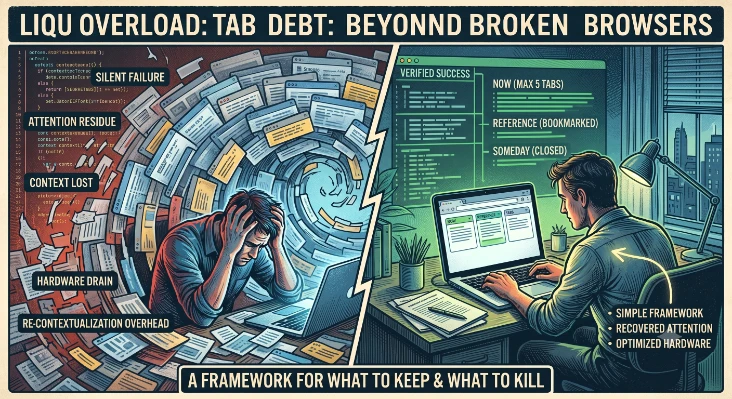
Look at your browser bar right now. If you are like most people, you have somewhere between 20 and 50 tabs open—several of which you could not explain if asked under oath. That number is not just a quirky habit; it is a measurable tax on your focus, and most of that cost is invisible until you actually quantify it.
Why You Can’t Just “Close Them”
Every open tab represents an unmade decision: a article to read later, an email to reply to, or a form to finish. Psychologists call this constant pull the Zeigarnik Effect—our brain’s natural tendency to fixate on incomplete tasks far more than finished ones.
A browser tab is simply a to-do item wearing a disguise. Your brain knows it, and it keeps tracking that open loop even when the window is minimized.
The Hidden Triple-Tax
Tab overload accumulates three distinct costs simultaneously—and only one of them affects your hardware:
- Hardware Drain: Modern browsers isolate each tab into its own process. Keeping 40+ tabs active eats up RAM fast—causing system slowdowns that people usually blame on an “aging laptop.”
- Attention Residue: Task-switching research shows that a portion of your cognitive capacity remains anchored to previous tasks. Every visible tab continuously pulls a sliver of your focus away from your active work.
- Re-contextualization Overhead: The tab you saved three days ago to “check later” now takes more time to relocate and re-understand than it would have taken to resolve in the first place.
The Asymmetry of Closing vs. Opening
Opening a tab takes one click and zero cognitive effort. Closing a tab requires a micro-decision: confirming that the information is safe to lose.
This structural asymmetry is why tab counts only increase over time. It is not a lack of personal discipline—it is a decision-cost problem.
A Simple Framework to Liquidate Tab Debt
To break the cycle, route every open tab into one of three strict categories and assign it a home outside your main bar:
- Now (Max 5 Tabs): Active work for today only. Keep these open.
- Reference: Useful information, but not required today. Bookmark it or push it to a read-later app, then kill the tab.
- Someday: Opened out of casual curiosity. Close it immediately. If it actually matters in the future, search will bring it back.
The Someday bucket is where real recovery happens—it’s the category people rarely clean out voluntarily. A quick 5-minute audit using this framework consistently eliminates 60% to 70% of open tabs, leaving behind only the context that actually warrants your attention.
Analysis by

Decision science researcher focusing on second-order effects and the time-based economics of technology. Expert in workflow optimization and cognitive load management.