
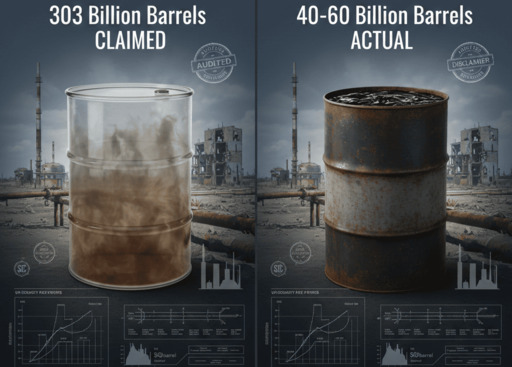
The assertion that Venezuela holds the world’s largest proven oil reserves—a claim repeated by government officials, international media, and even some industry analysts—rests entirely on a single administrative figure: 303 billion barrels. This number has been used to justify economic policies, attract foreign investment, and position Venezuela as a global energy superpower. However, when subjected to rigorous technical scrutiny using internationally accepted petroleum engineering standards, this figure reveals itself to be a statistical construct rather than an operational reality.
The distinction between geological resources and commercially recoverable reserves is not semantic—it represents the fundamental difference between theoretical potential and actual economic value. This analysis demonstrates why the vast majority of Venezuela’s reported reserves fail to meet the technical, operational, and economic criteria that define proven reserves in the modern petroleum industry.
Reserves vs. Resources: The Critical Distinction the Industry Makes
The petroleum industry operates under a rigorous classification system that distinguishes between various categories of hydrocarbons based on their recoverability. This is not arbitrary bureaucracy—it is essential for investment decisions, financial reporting, and realistic production planning. The SEC, which regulates public company reporting in the United States, defines proven reserves with four mandatory criteria that must be satisfied simultaneously:
SEC Rule 4-10(a)(22) – Proved Oil and Gas Reserves:
“Those quantities of oil and gas, which, by analysis of geoscience and engineering data, can be estimated with reasonable certainty to be economically producible—from a given date forward, from known reservoirs, and under existing economic conditions, operating methods, and government regulations.”
Each word in this definition carries legal and technical weight. “Reasonable certainty” means a 90% probability (P90) in industry terminology. “Existing economic conditions” means current prices and costs, not hypothetical future scenarios. “Operating methods” means technologies actually deployed and functional, not theoretical capabilities. This framework exists precisely to prevent the kind of reserve inflation that characterizes Venezuela’s reporting.
The Orinoco Oil Belt, which accounts for approximately 270 billion barrels of Venezuela’s total, fails at least three of these four criteria. The geological certainty exists—the oil is physically present in the ground. However, the technical feasibility has not been demonstrated at scale, the infrastructure remains largely unbuilt or non-functional, and the economic viability is questionable at current market prices. Under SPE-PRMS classification, these volumes should be categorized as Contingent Resources (2C) or even Prospective Resources (2U), not as proven reserves.
The Recovery Factor Controversy: How 150 Billion Barrels Appeared on Paper
Between 2005 and 2011, Venezuela’s officially reported reserves increased dramatically from approximately 80 billion barrels to over 290 billion barrels. This was not the result of major new discoveries—no significant new fields were found during this period. Instead, it resulted from a unilateral decision to apply a 20% recovery factor to the original oil in place (OOIP) in the Orinoco Belt, which contains an estimated 1.2 to 1.3 trillion barrels of oil in place.
The recovery factor is the percentage of oil in place that can be extracted using available technology and economic constraints. For conventional light oil with water or gas injection, recovery factors of 30-50% are common. For extra-heavy oil like that in the Orinoco, recovery factors are significantly lower due to high viscosity, low permeability, and the need for enhanced recovery methods.
| Category | Recovery Factor | Basis |
|---|---|---|
| Official Venezuelan Estimate | 20% | Assumes full deployment of thermal EOR (SAGD, CSS) |
| Zuata Field (Actual) | ~3.5% | After 25+ years of production |
| Cold Production Average | 5-8% | Primary recovery without thermal methods |
| With Full Thermal EOR | 12-18% | Requires massive infrastructure investment |
The critical issue is that the 20% recovery factor assumes technologies and infrastructure that do not currently exist in Venezuela. Steam-Assisted Gravity Drainage (SAGD) and Cyclic Steam Stimulation (CSS) are proven technologies in Canada’s oil sands, but they require continuous steam generation, water treatment facilities, horizontal drilling capabilities, and massive upfront investment. Venezuela has built only a fraction of this infrastructure, and much of what was constructed in the 1990s and early 2000s is now non-operational due to underinvestment and lack of maintenance.
- Investment of $200-300 billion in thermal EOR infrastructure
- 10-15 years of construction and development
- Stable political and regulatory environment
- Oil prices above $70-80/barrel sustained over decades
- Access to technology and capital markets
Counting these barrels as “proven reserves” violates every standard of petroleum economics. They are not difficult-to-extract reserves—they are conditional future possibilities.
Physical-Chemical Constraints: The Thermodynamic Reality of Extra-Heavy Crude
The oil in the Orinoco Belt is not simply “heavy”—it is extra-heavy, approaching the consistency of bitumen at reservoir temperatures. Understanding why this matters requires examining the fundamental physical properties that govern oil production and transportation.
| Property | Orinoco Crude | Saudi Light | WTI Benchmark |
|---|---|---|---|
| API Gravity | 8°-10° | 34° | 39.6° |
| Viscosity | 1,000-10,000+ cP | ~10 cP | ~5 cP |
| Sulfur Content | 2.5-4.5% | 1.7% | 0.24% |
| Metals (V+Ni) | 500-1,500 ppm | ~30 ppm | ~15 ppm |
| Flowability | Does not flow naturally | Flows freely | Flows freely |
The viscosity difference is not merely a technical inconvenience—it represents a fundamental barrier to extraction and transport. Orinoco crude at reservoir temperature (around 50-60°C) has viscosity 1,000 to 10,000 times higher than conventional crude. At lower temperatures, it essentially becomes solid. This creates cascading operational requirements:
- Extraction: Requires thermal methods (steam injection), horizontal wells, or solvent dilution to achieve any flow
- Transportation: Cannot be pumped through pipelines without heating or dilution with lighter hydrocarbons
- Processing: Requires specialized upgraders or refineries with coking capacity
- Marketing: Trades at $10-20 discount per barrel compared to benchmarks
Infrastructure Deficit: The Missing Link Between Resource and Reserve
A hydrocarbon deposit becomes a reserve only when it is connected to functioning infrastructure that can extract, process, transport, and market the product. Venezuela’s infrastructure deficit is not a temporary maintenance issue—it represents a systemic collapse of the value chain required to monetize the resource.
Critical Infrastructure Status (January 2026):
- José Antonio Anzoátegui (190,000 bpd capacity): Operating at ~30-40% capacity with frequent shutdowns
- Petromonagas (110,000 bpd capacity): Extended maintenance, sporadic operation
- Petrocedño (100,000 bpd capacity): Partially operational, equipment degradation
- Petropiar (200,000 bpd capacity): Operating below 50% capacity
Combined: Nominal capacity of 600,000 bpd; actual operational capacity estimated at 150,000-250,000 bpd
The upgraders are not optional processing facilities—they are absolutely necessary to convert extra-heavy crude into a marketable product (synthetic crude with 26-32° API). Without sufficient upgrading capacity, Venezuela can only export diluted crude oil (DCO), which commands significantly lower prices and requires ongoing diluent imports.
Beyond upgraders, the broader infrastructure presents systematic failures:
- Pipeline Network: Corrosion, leaks, limited capacity, insufficient heating systems
- Storage Terminals: Tank degradation, limited blending capacity, contamination issues
- Export Facilities: Port dredging requirements, loading system failures, limited vessel availability
- Water Treatment: Essential for steam generation, largely non-functional
- Power Supply: Unreliable electricity grid affecting pumping and heating systems
Economic Viability: The Breakeven Analysis That Disqualifies Most “Reserves”
The final and perhaps most decisive test for proven reserves is economic viability. The SEC explicitly requires that reserves be “economically producible…under existing economic conditions.” This is not a minor technicality—it is the fundamental distinction between a resource that creates value and one that destroys it.
| Production Type | Breakeven Price | Source |
|---|---|---|
| Existing wells (cold production) | $25-35/barrel | Operating costs only |
| New development (no thermal EOR) | $42-49/barrel | Rystad Energy, BloombergNEF |
| New development with thermal EOR | $60-80/barrel | Wood Mackenzie, industry estimates |
| Greenfield with full infrastructure | $80-100+/barrel | Full-cycle development costs |
These breakeven prices must be compared not to theoretical oil prices, but to the actual netback prices Venezuela receives after quality discounts, transportation costs, and diluent costs:
- Brent Reference Price: $60.00/barrel
- Quality Discount (API 8-10° vs 38°): -$12.00/barrel
- Freight to Market: -$3.00/barrel
- Diluent Cost (net of recovery): -$5.00/barrel
- Marketing/Transaction Costs: -$2.00/barrel
- = Net Realized Price: $38.00/barrel
At a netback of $38/barrel, only production from existing wells with minimal additional investment generates positive cash flow. New development projects with thermal EOR—precisely the projects that would be required to achieve the 20% recovery factor—are deeply uneconomic. This means the vast majority of the 303 billion barrels are not economically producible under existing conditions, and therefore do not qualify as SEC-compliant proven reserves.
The Canadian Comparison: Infrastructure Built vs. Infrastructure Imagined
Venezuela frequently compares itself to Canada, which has successfully monetized similar extra-heavy oil and bitumen resources. However, this comparison reveals precisely why Canada’s oil sands qualify as reserves while Venezuela’s Orinoco resources largely do not.
Both countries possess geologically similar resources: heavy to extra-heavy hydrocarbons with low API gravity, high viscosity, and significant upgrading requirements. The critical difference lies in what was built, not what exists underground.
- SAGD Facilities: Over 50 major SAGD projects producing ~1.5 million bpd
- Mining Operations: Large-scale surface mining with upgrading capacity
- Upgraders: 5 major complexes with total capacity exceeding 1 million bpd
- Pipeline Network: Integrated system connecting to multiple markets
- Refineries: Domestic and US refineries configured for heavy crude
- Technological Innovation: Continuous improvement in extraction efficiency
- Water Management: Recycling systems achieving 80-95% water reuse
- Regulatory Framework: Stable, transparent, predictable rules
Canada invested over $200 billion over three decades to build this infrastructure. The result is not hypothetical reserves, but actual production of 3+ million barrels per day with demonstrated profitability cycles. When Canadian companies report reserves to the SEC, they can point to operating facilities, established recovery rates, and historical production data.
Venezuela’s path was fundamentally different. In the 1990s, through the Apertura Petrolera (Oil Opening), Venezuela began developing the Orinoco Belt with international partners. Several strategic associations were formed, and upgrader construction began. However, by the mid-2000s, policy shifted toward nationalization, foreign partners were forced to accept minority positions or leave, and new infrastructure development largely ceased. The critical difference:
- Canada: Certified reserves based on infrastructure built and operated
- Venezuela: Certified reserves based on infrastructure planned but never constructed
Quantifying the Real Reserves: A Conservative Technical Estimate
Given the evidence presented—recovery factor realities, physical-chemical constraints, infrastructure limitations, and economic thresholds—what is a realistic estimate of Venezuela’s actual proven reserves under international standards?
| Category | Billion Barrels | Justification |
|---|---|---|
| Conventional Light-Medium Crude | 12-15 | Traditional fields in Western basin, Lake Maracaibo |
| Heavy Crude (Existing Development) | 8-12 | Developed heavy oil fields with infrastructure |
| Orinoco (Cold Production Only) | 15-25 | 5-8% RF on developed acreage, existing wells |
| Orinoco (With Current Upgraders) | +5-8 | Additional recovery via existing (degraded) infrastructure |
| TOTAL PROVEN RESERVES | 40-60 | Economically recoverable under current conditions |
| Contingent Resources (2C) | 80-120 | Requires major infrastructure investment |
| Prospective Resources | 120-180 | Requires technology not yet demonstrated at scale |
This analysis suggests Venezuela’s actual proven reserves are in the range of 40-60 billion barrels—still substantial, ranking among the top 10 globally, but only 15-20% of the officially claimed figure. The remainder should be classified as contingent or prospective resources, indicating they could potentially become reserves in the future under different technical, economic, or political conditions—but they are not reserves today.
Technical Conclusion: From Myth to Reality
The evidence is conclusive and multi-dimensional: Venezuela does not possess 303 billion barrels of proven oil reserves according to internationally accepted petroleum engineering and financial reporting standards.
The country possesses approximately 40-60 billion barrels of economically recoverable reserves under current conditions, with an additional 80-120 billion barrels of contingent resources that could become reserves with massive infrastructure investment, technological deployment, stable governance, and favorable long-term oil prices.
The distinction between these categories is not semantic or political—it reflects fundamental realities of physics, engineering, economics, and operations. Oil that cannot flow without technology that doesn’t exist, cannot be processed through infrastructure that isn’t built, cannot be sold at prices that don’t cover costs, and cannot be developed without capital that isn’t available is not a reserve. It is a resource—a geological fact with potential future value, but not a current asset.
In the modern oil industry, where capital is allocated based on risk-adjusted returns and reserves must be certified by independent engineers under SEC scrutiny, this distinction determines investment decisions, company valuations, and national energy strategies. Venezuela’s reserve reporting represents one of the most significant disconnects between official statistics and operational reality in global energy markets.
Understanding this gap is essential for realistic assessments of:
- Venezuela’s actual production capacity and growth potential
- Investment requirements to develop additional resources
- Government revenue projections from oil exports
- The country’s strategic position in global energy markets
- The validity of economic policies predicated on reserve-based assumptions
Sources and Methodological Framework
This analysis is grounded in internationally recognized petroleum engineering standards, regulatory frameworks, and independent energy research. The following sources provide the technical foundation, economic data, and comparative benchmarks used throughout this assessment.
Industry Standards and Regulatory Frameworks
Society of Petroleum Engineers (SPE) – Petroleum Resources Management System
Document: Petroleum Resources Management System (PRMS) – 2018 Update
Link: https://www.spe.org/en/industry/petroleum-resources-management-system-2018/
The SPE-PRMS provides the global standard for classifying petroleum resources into categories (Reserves, Contingent Resources, Prospective Resources) based on technical maturity, commercial viability, and project commitment. This framework is used by international oil companies, financial institutions, and regulatory agencies worldwide to ensure consistent and transparent resource reporting. The 2018 update incorporated modern best practices and aligned with UN Framework Classification for Resources (UNFC).
Relevance: Establishes the technical definitions distinguishing proven reserves from contingent and prospective resources. Venezuela’s reserve classification fails multiple PRMS criteria for proven reserves.
U.S. Securities and Exchange Commission (SEC) – Oil and Gas Reserves Definitions
Regulation: 17 CFR § 210.4-10 – Financial Accounting and Reporting for Oil and Gas
Link: https://www.law.cornell.edu/cfr/text/17/210.4-10
Additional Reference: SEC Staff Guidance on Oil and Gas Rules
Link: https://www.sec.gov/rules-regulations/staff-guidance/compliance-disclosure-interpretations/oil-gas-rules
Rule 4-10(a)(22) defines “Proved Oil and Gas Reserves” as quantities that can be estimated with reasonable certainty to be economically producible under existing economic conditions, operating methods, and government regulations. This legal framework governs reserve reporting by all publicly traded U.S. oil and gas companies and provides the strictest and most legally enforceable reserve definition in global use.
Relevance: The SEC standard requires simultaneous satisfaction of geological certainty, technical feasibility, infrastructure availability, and economic viability. Venezuela’s reserves fail the economic viability test at current prices and the infrastructure availability test at current development status.
Energy Economics and Market Analysis
Rystad Energy – Global Oil Supply and Breakeven Cost Analysis
Report: Venezuela Breakeven Prices and Production Economics (2020-2026)
Reference: BloombergNEF citing Rystad Energy data
Additional Source: Incorrys Analysis – Full-Cycle Cost of Venezuelan Oil
Rystad Energy, a leading independent energy research firm, estimated Venezuela’s breakeven prices in 2020 at $42-56 per barrel overall, with the Orinoco Belt specifically at $49.26 per barrel. These figures represent operating costs plus required capital returns for new development, but do not include full greenfield infrastructure costs, which would significantly increase breakeven thresholds to $70-100+ per barrel for undeveloped acreage.
Relevance: Demonstrates that significant portions of Venezuela’s claimed reserves are uneconomic at current market prices (~$60 Brent, less quality discounts), failing the SEC economic viability requirement.
Wood Mackenzie – Latin America Upstream Research
Analysis: Venezuelan Oil Production Costs and Development Economics
Reference: OilPrice.com citing Wood Mackenzie estimates | LinkedIn Industry Discussion
Wood Mackenzie, a global energy consultancy, estimates breakeven costs for key grades in the Orinoco Belt at over $80 per barrel for new production. This places Venezuelan heavy crude at the higher end of the global cost curve, significantly above Canadian oil sands (~$55/barrel) and conventional Middle Eastern production ($10-25/barrel).
Wood Mackenzie also estimates that maintaining current production levels would require $53 billion through 2040, while increasing production above 1.4 million bpd would require an additional $120 billion in capital investment.
Relevance: Independent verification that large-scale Orinoco development is uneconomic at prices below $80/barrel, confirming that the majority of claimed reserves fail economic viability tests.
BloombergNEF – Venezuela Oil Economics and Infrastructure Analysis
Report: Venezuela’s Oil Renaissance Faces Several High Hurdles (January 2026)
Link: https://about.bnef.com/insights/commodities/venezuelas-oil-renaissance-faces-several-high-hurdles/
Bloomberg New Energy Finance provides comprehensive analysis of Venezuela’s oil sector economics, infrastructure status, and investment requirements. Their 2026 assessment highlights that even with sanctions relief, Venezuela faces structural challenges including degraded infrastructure, technology gaps, and capital constraints that limit near-term production growth.
Relevance: Confirms infrastructure limitations that prevent monetization of claimed reserves, supporting the argument that resources without functional infrastructure cannot be classified as proven reserves.
Academic and Policy Research
Baker Institute for Public Policy (Rice University) – Latin America Energy Program
Program Director: Francisco J. Monaldi, Ph.D.
Institution Link: https://www.bakerinstitute.org/research/after-maduros-ouster-what-happens-venezuelas-oil
Recent Analysis: Without Institutional Change, Venezuela’s Oil Bonanza Remains Unviable (Americas Quarterly, January 2026)
The Baker Institute’s Latin America Energy Program, directed by Dr. Francisco Monaldi, provides authoritative research on Venezuela’s petroleum sector. Dr. Monaldi’s analysis demonstrates that Venezuela’s production decline from 3.4 million bpd to under 1 million bpd resulted from policy instability, broken contracts, and institutional collapse rather than geological constraints. His research estimates that returning to 1970s production levels would require $100 billion in investment over a decade ($10 billion annually).
Relevance: Academic validation that Venezuela’s reserve problems are institutional and infrastructural, not geological, and that claimed reserves lack the operational and economic foundations required by international standards.
International Energy Agencies
International Energy Agency (IEA) – Oil Market Reports and Analysis
Recent Analysis: IEA Chief Economist on Venezuela Production Potential (January 2026)
Link: https://www.reuters.com/business/energy/ramping-oil-production-venezuela-will-yield-limited-short-term-gains-iea-says-2026-01-13/
Market Overview: IEA Sees Oil Market ‘Buffer’ Despite Venezuela Uncertainty (Energy Intelligence, January 2026)
IEA Chief Energy Economist Tim Gould stated in January 2026: “It seems somewhat misleading to hear the frequent claims about Venezuela’s vast oil reserves or resources. As we are all aware, they are challenging to extract and difficult to market.” The IEA notes that Venezuela’s “dilapidated, outdated oil infrastructure” requires substantial investment before resources can be effectively brought to market, and that short-term production increases will be limited.
Relevance: The world’s leading energy policy organization explicitly acknowledges the disconnect between Venezuela’s claimed reserves and operational reality, supporting the technical critique presented in this analysis.
Technical Engineering Studies
OSTI – Estimating Technically Recoverable Reserves in the Faja Petrolífera del Orinoco
Study: Technical Assessment of Orinoco Belt Recovery Factors
Link: https://www.osti.gov/etdeweb/biblio/21025378
Technical engineering study examining the recovery factor assumptions applied to the Orinoco Belt, analyzing the gap between theoretical 20% recovery projections and observed field performance. The study provides detailed analysis of reservoir characteristics, production mechanisms, and the infrastructure requirements necessary to achieve enhanced recovery factors.
Relevance: Provides technical foundation for understanding why official recovery factor assumptions (20%) significantly exceed demonstrated field performance (3.5-8%), explaining approximately 150+ billion barrels of inflated reserve claims.
SPE OnePetro – Enhanced Oil Recovery Project Outcomes in Heavy Oil Reservoirs
Paper: IOR/EOR Project Implementation Outcomes and Novel Technologies in Venezuelan Heavy Oil Fields
Link: https://onepetro.org/SPEADIP/proceedings-abstract/24ADIP/24ADIP/585264
Peer-reviewed technical paper analyzing actual enhanced oil recovery (EOR) performance in Venezuelan heavy oil fields, including long-term production data from pilot projects and commercial operations. Documents observed recovery factors from thermal and non-thermal EOR methods in Orinoco Belt conditions.
Relevance: Provides empirical data on actual recovery rates achieved in Venezuelan extra-heavy oil, demonstrating the gap between theoretical projections and operational reality.
Comparative Analysis and Industry Benchmarking
Canadian Oil Sands vs. Venezuelan Heavy Oil: Infrastructure Comparison
Analysis: Strategic and Operational Differences Between Analogous Resources
Reference: Canada Oil Sands vs Orinoco Heavy Oil: Strategic Comparison (Industry Analysis, January 2026)
Production Data: How Venezuelan Crude Could Affect Canadian Producers (CBC News, December 2025)
Comparative analysis of geologically similar heavy oil and bitumen resources in Canada (Alberta oil sands) and Venezuela (Orinoco Belt). Despite similar reservoir characteristics, Canada has successfully commercialized resources through sustained infrastructure investment, technological innovation (SAGD), stable regulatory frameworks, and market integration. Canada produces over 3 million bpd from resources once considered as challenging as Venezuela’s.
Relevance: Demonstrates that the key differentiator between resources and reserves is not geology but infrastructure, technology deployment, and institutional stability—areas where Venezuela has failed to build the necessary foundation.
Recent Market and Operational Assessments (2026)
Current Production Realities and Investment Requirements
Reuters Analysis: Venezuela’s Oil Claims Are a Slick, Goopy Mess (Breakingviews, January 2026)
Industry Perspective: US Oil Capital Houston Buzzes as Industry Limbers Up for Venezuela (Reuters, January 2026)
Resource Analysis: 303 Billion Barrels of Oil and a Harsh Reality (ISANS, January 2026)
Recent industry assessments following Venezuela’s political transition in January 2026 provide updated analysis of production capacity, infrastructure status, and investment requirements. These reports confirm that despite political changes, the fundamental technical and economic constraints remain: degraded infrastructure, high production costs, quality discounts, and massive capital requirements ($100-200 billion) for meaningful production increases.
Relevance: Contemporary market analysis confirming that Venezuela’s reserve claims remain disconnected from operational and economic reality even after recent political developments.
Methodological Note
Analytical Framework: This assessment applies the most stringent internationally recognized standards—SEC Rule 4-10(a)(22) and SPE-PRMS 2018—to evaluate Venezuela’s reserve claims. These standards are not arbitrary; they represent industry consensus developed over decades to ensure that “reserves” represent economically recoverable hydrocarbons under current conditions, not geological potential or future possibilities.
The analysis integrates:
- Regulatory definitions (SEC, SPE-PRMS) establishing legal and technical standards
- Economic analysis (Rystad, Wood Mackenzie, BloombergNEF) quantifying breakeven costs and investment requirements
- Technical engineering (OSTI, SPE papers) documenting actual field performance and recovery rates
- Policy research (Baker Institute, IEA) contextualizing institutional and operational constraints
- Comparative benchmarking (Canada vs. Venezuela) demonstrating infrastructure requirements for resource commercialization
All quantitative estimates and conclusions are derived from published, peer-reviewed, or professionally audited sources. Where ranges are provided, they reflect uncertainty inherent in subsurface resource estimation and economic forecasting, with conservative assumptions applied throughout.
Updated January 2026
This analysis incorporates the most recent data available as of January 26, 2026, including updated assessments from the IEA, BloombergNEF, and Baker Institute following recent political developments in Venezuela. Technical standards (SEC Rule 4-10, SPE-PRMS 2018) remain current and unchanged. Economic data reflects oil prices, costs, and market conditions prevailing in January 2026.
Analysis by

Decision science researcher focusing on second-order effects and the time-based economics of technology. Expert in workflow optimization and cognitive load management.