
Have you ever stopped to wonder where your “delete” button actually goes? You click it, the icon vanishes, and your screen returns to its pristine, curated state. You feel a sense of relief—a digital weight lifted. But what if I told you that “delete” is often just a polite suggestion? What if your most private thoughts, your financial fingerprints, and your late-night search history aren’t floating in a metaphorical “cloud,” but are physically etched into a spinning disk in a concrete bunker located in a jurisdiction that doesn’t recognize your right to exist?
Welcome to the Geopolitics of Tools. This isn’t just about software; it’s about soil, sovereignty, and the invisible borders that determine whether your data belongs to you—or to a state you’ve never visited.
The Illusion of the Borderless Web
Since the early 90s, we’ve been sold a dream: the Internet is a global village. A borderless utopia where information flows like water. But that’s the first layer of the mask. In reality, the internet is one of the most physically grounded infrastructures ever built—a massive network of undersea cables, humming server farms, and cooling towers consuming enough electricity to power entire nations.
Every time you use a “tool”—a project management app, a secure messenger, or a cloud drive—you are effectively teleporting a piece of your identity to a specific GPS coordinate. And the moment that data crosses a physical border, it undergoes a transformation. It stops being “yours” in the way you understand it and starts being subject to the Lex Loci—the law of the land.
Here’s the unsettling truth: your data doesn’t live in a cloud. It lives in a building. And that building has an address. And that address has a flag.
The Three Jurisdictional Blocs (2026)
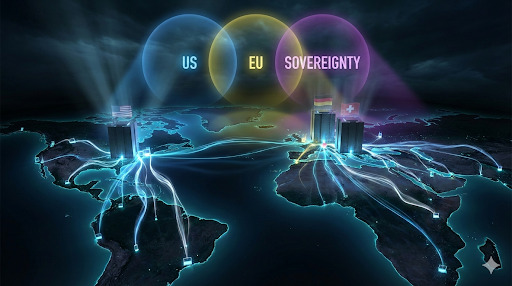
The map of the digital world is no longer a single web; it has fractured into three distinct ideological and legal fortresses. Each one treats your data rights as a different kind of commodity.
1. The US Silicon Valley Bloc: The CLOUD Act and Infinite Reach
This is the home of the “efficiency over everything” mantra. If your data is hosted by a US company, you are living under the shadow of the U.S. CLOUD Act (Clarifying Lawful Overseas Use of Data Act).
This piece of legislation is a geopolitical masterstroke. It grants the U.S. government the power to compel U.S.-based service providers to turn over data, even if that data is stored on a server outside the United States. If the company is American, the data is American. Period. The server could be in Iceland, Frankfurt, or Tokyo—it doesn’t matter. The jurisdiction follows the company, not the soil.
Here’s where it gets murky: the Third Party Doctrine historically allowed government access to your data without a warrant if you “voluntarily” gave it to a third party. However, the 2018 Carpenter v. United States case created cracks in this doctrine. The Supreme Court ruled that certain digital data—particularly location tracking—maintains Fourth Amendment protection even when held by third parties. But this protection is partial and evolving. Courts are still deciding which data deserves protection and which doesn’t. Your Notion notes? Still unclear. Your browsing metadata? Likely fair game.
The physical heart of this bloc is Northern Virginia, managing a staggering 6,247 MW of global infrastructure capacity—almost triple that of the second-largest data center hub.
This isn’t just a tech hub; it is the most concentrated point of digital “soil” on the planet. When you use an American tool, your data almost certainly passes through this single geographic chokepoint, regardless of where you are in the world.
2. The EU Fortress Bloc: GDPR as Digital Sovereignty
In Europe, the philosophy is different. They view data through the lens of Digital Sovereignty. Led by the GDPR, this bloc enforces a “Right to be Forgotten” that comes with teeth sharp enough to draw blood.
If a tool cannot guarantee the reversibility of your data—meaning they can’t prove they’ve scrubbed every trace of you upon request—they face fines of up to €20 million or 4% of total global annual turnover, whichever is higher. In 2023, Meta was hit with a €1.2 billion fine for violating data transfer rules. For context, that’s not a cost of doing business—that’s an existential threat.
This bloc is also the most aggressive about Cross-Border Data Transfer Restrictions. They don’t want your data leaving the fortress because they know that once it lands on US or Asian soil, the EU’s “protection spells” stop working. The invalidation of the EU-US Privacy Shield and the ongoing scrutiny of Standard Contractual Clauses reflect a simple reality: Europe doesn’t trust anyone else with your data.
But here’s the shadow side: GDPR enforcement is uneven. Irish and Luxembourgish regulators—where most tech giants have their EU headquarters—have been criticized for slow enforcement. The protection exists on paper, but the speed at which it’s enforced varies wildly between member states.
3. The Asia-Pacific Sovereignty Bloc: Data as National Resource
This is where the concept of the “Cloud” completely evaporates into the reality of the “Soil.” Countries like China, with the PIPL (Personal Information Protection Law) and the Cybersecurity Law, treat data as a national resource—like oil, gold, or uranium.
In this bloc, Data Localization is non-negotiable. You cannot host your data outside the country if you want to operate within it. China’s amended Cybersecurity Law (effective January 1, 2026) tightened these requirements even further. Reversibility here is often a mirage: you can “delete” it from your view, but the state requires the provider to keep a copy in the shadows for “national security” audits.
Similarly, Australia has implemented a 2-year metadata retention mandate for telecommunications providers. Your ISP is legally required to keep the “envelope” of your digital life—who you talked to, when, and from where—for two full years, even if you delete the contents of the messages themselves. This isn’t about content; it’s about the pattern of your life, which in the age of AI, is often more revealing than the words themselves.
Vietnam joined the data sovereignty wave on January 1, 2026, with new comprehensive data protection laws. The map is expanding.
The Splinternet Reality: Fractured Digital Borders
We are no longer using one internet. We are using a Splinternet—the fragmentation of the web into regional bubbles governed by local politics and incompatible legal frameworks.
In the Splinternet, your “rights” are a moving target. If you are a journalist in a sensitive region using a tool hosted in a jurisdiction that practices Mutual Legal Assistance Treaties (MLATs) with your local government, you are effectively working in a glass house. The tool becomes the intermediary that can be compelled to hand over your work—not through hacking, but through paperwork.
The geopolitics of server location creates Legal Arbitrage. Companies strategically position their servers where laws are most favorable to them, not you.
A tool might claim “End-to-End Encryption,” but if their metadata servers are in a jurisdiction that allows “secret warrants” or National Security Letters with automatic gag orders, the encryption is just a fancy lock on a door with no walls.
The TikTok saga is the clearest example. Despite “Project Texas”—a proposal to store all US user data on Oracle servers within the United States—the U.S. government rejected the arrangement as insufficient and passed legislation requiring divestment or shutdown. The message was clear: server location alone doesn’t solve jurisdictional risk when the parent company is bound to a foreign state.
Case Studies: Real Tools, Real Trade-offs
To understand the weight of this, let’s examine the tools we use every day:
Google Workspace: The Jurisdictional Paradox
The pinnacle of collaboration. Google offers Data Regions (US, EU, or no preference) on Business and Enterprise plans. You can choose to keep your data in European data centers. But here’s the catch: because Google is a U.S. entity, every document is ultimately subject to the CLOUD Act. Even if you are a German company storing data on Google’s Frankfurt servers, a U.S. warrant can technically reach across the Atlantic and compel Google to produce that data without the German government’s knowledge or consent.
Notion: The AWS Shadow
One of the world’s most popular “second brains.” Notion stores data primarily on AWS infrastructure (Amazon Web Services), with default servers in Oregon and Ohio. Because AWS is a U.S.-based cloud provider, the jurisdictional gravity of Virginia applies to your Notion notes, regardless of Notion’s own privacy intentions. Notion does offer EU data residency—but only for Enterprise plans requiring contact with a sales team. For the average user, your thoughts live under American law.
Proton/Signal: Geopolitical Positioning as a Feature
These tools have made jurisdictional arbitrage their primary selling point. By incorporating in Switzerland (outside the direct US/EU/China blocs) and using zero-knowledge encryption, they attempt to make the “soil” irrelevant. If the company can’t decrypt your data, jurisdiction becomes less critical. However, even Switzerland is subject to international pressure through “anti-terror” intelligence-sharing pacts. The fortress walls are real, but not impenetrable.
Actionable Checklist for Digital Sovereignty
How do you navigate this invisible map? You have to stop looking at the “About Us” page and start examining the Geopolitical DNA of your tools. Use this Sovereignty Score checklist:
- Jurisdiction of Incorporation: Is the company based in a “Five Eyes” intelligence-sharing nation (US, UK, CA, AU, NZ)? If yes, your data is inherently more “transparent” to those states.
- Physical Server Location: Does the tool allow you to choose your server region (e.g., “EU-only hosting”)? Is this choice available on your pricing tier, or locked behind Enterprise paywalls?
- Third-Party Dependencies: Who provides their infrastructure? If the tool is Swiss but uses AWS or Google Cloud for storage, the Swiss protection is a thin veneer over American jurisdiction.
- Transparency Reports: Does the company publish how many government requests for data they receive—and more importantly, how many they fight? Silence is telling.
- Zero-Knowledge Architecture: Does the company have the technical ability to see your data? If they don’t hold the encryption keys, jurisdiction matters significantly less.
- Data Portability Tools: Can you export all your data—including metadata—in a standard format (JSON, CSV) without contacting support?
- CLOUD Act Exposure: If the company or its infrastructure provider is U.S.-based, assume CLOUD Act applies.
Conclusion: Soil Beats Cloud Every Time
We like to think of our digital lives as ethereal, floating above the messy reality of maps and borders. But every byte of your data eventually has to land somewhere. It has to sit on a rack, in a room, on a piece of dirt owned by a sovereign power.
The next time you sign up for a “revolutionary new productivity tool,” ask yourself: If I wanted to disappear tomorrow, would this jurisdiction let me? Or am I just feeding a ghost that will haunt a server room in a desert—or a bunker in Virginia—halfway across the world forever?
Geopolitics isn’t just for politicians anymore. It’s for anyone with a smartphone. Because in the digital age, your location is fixed not by where you stand, but by where your data sleeps.
And that sleep is never as peaceful as you think.
Start Your Sovereignty Audit Today
Map every tool you use daily. Find out where the company is incorporated, where the servers physically sit, and what laws govern both. The first step to digital sovereignty is knowing which flag flies over your data. Because in the end, the soil always wins.
FAQs: Data Sovereignty & Server Location
Does server location really matter for my privacy?
Yes. Server location determines which country’s laws apply to your data, which authorities can demand access, and what rights you have to delete or move it. Even with strong security, jurisdiction can enable secret orders, mandatory metadata retention, or limit your right to be forgotten.
What is data sovereignty in simple terms?
Data sovereignty means your data is governed by the laws of the place where it physically lives. If your files are on a server in Germany, German and EU laws apply; if they are in Virginia, U.S. law and the CLOUD Act come into play.
Can the US CLOUD Act access data stored in the EU?
In many cases, yes. If a provider is a U.S.-based company (or controlled by one), U.S. authorities can compel it to hand over data even when it is stored in the EU. The GDPR tries to limit this, but the legal conflict is ongoing and often resolved case by case.
Is GDPR enough to fully protect my data?
The GDPR is one of the strongest privacy frameworks in the world, but it is not an absolute shield. Its effectiveness depends on the provider’s jurisdiction, where the servers are located, third-party contracts, and how willing and able regulators are to enforce penalties.
Can I ever truly delete my data from the cloud?
It depends. Some services offer good technical reversibility, but backups, logs, and legal retention requirements can keep “ghosts” of your data. The closest you can get is combining: services with strong deletion tools, robust encryption, and copies stored under your own physical control.
Sources & Further Reading
- Clarifying Lawful Overseas Use of Data (CLOUD) Act – Overview
- GDPR Right to Be Forgotten (Right to Erasure) Explained
- GDPR Enforcement & High-Profile Fines for Data Transfers
- Data Sovereignty vs Data Residency – Compliance Guide
- Understanding Data Sovereignty & Jurisdictional Control
- What Is the Splinternet and Why It Matters
- How Virginia Became the Data Center Capital of the World
- Australia’s Telecommunication Metadata Retention Regime
- Global Privacy Laws in 2026 – Overview & Updates
- Data Protection Laws of the World – Country-by-Country Guide
Analysis by

Decision science researcher focusing on second-order effects and the time-based economics of technology. Expert in workflow optimization and cognitive load management.