
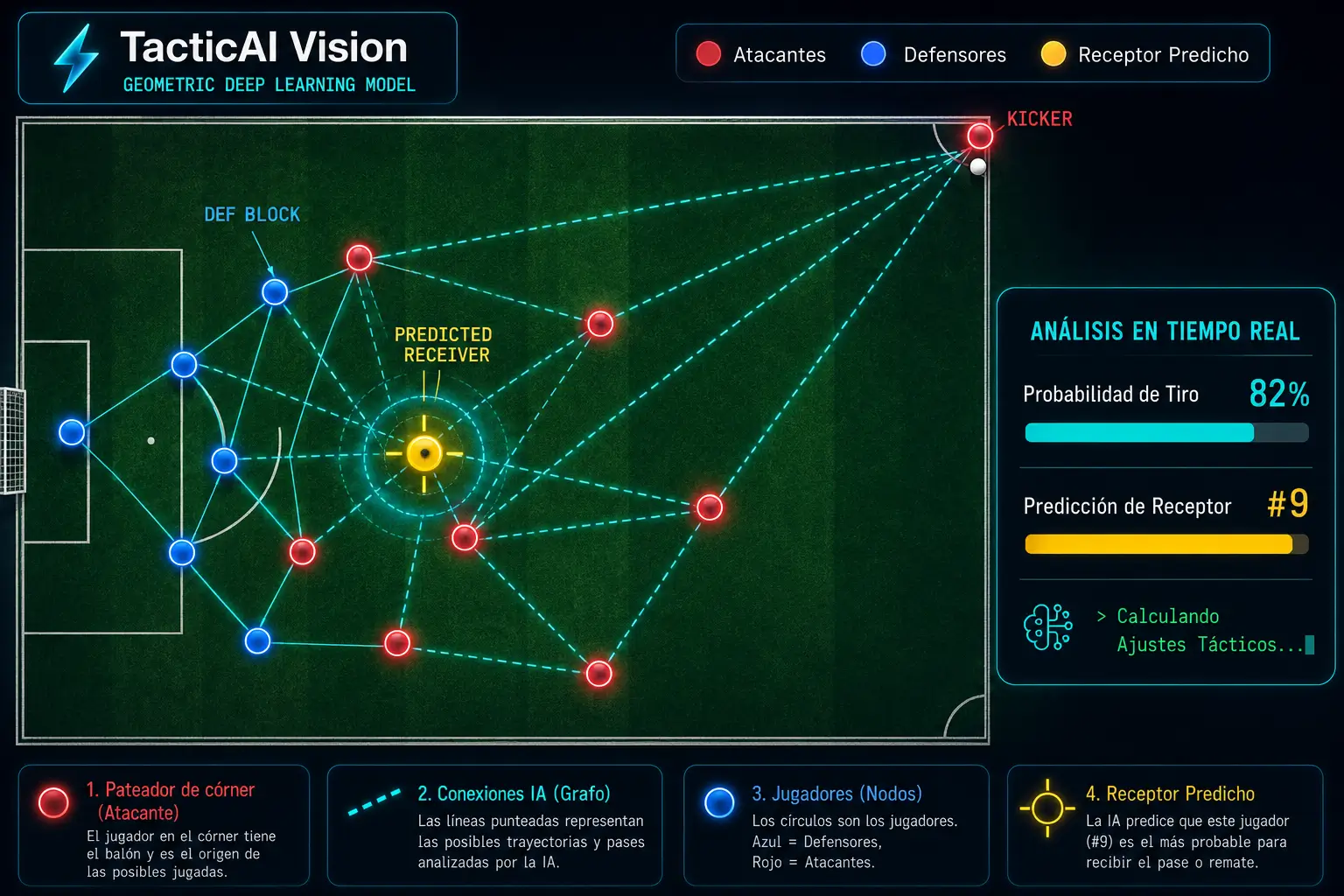
Football is a difficult place to test AI because almost everything is moving at once. Twenty-two players, a ball, changing space, fatigue, opponent reactions and decisions that make sense for only a fraction of a second.
Google DeepMind and Liverpool FC avoided that whole mess by starting with a much narrower problem: corner kicks.
That choice is more interesting than it looks. A corner begins from a fixed location, involves a compact phase of play and gives analysts a repeatable structure. It is still football, but it is football with enough constraints to make the data manageable.
The result was TacticAI, described in a 2024 peer-reviewed paper in Nature Communications.
TacticAI is not an AI that “solved football.” It is a good example of what happens when machine learning is given a narrow, structured tactical problem.
Why corners are unusually suitable for this
Open play is chaotic. A winger may cut inside, a midfielder may rotate, a defender may step forward and suddenly the geometry of the entire play changes.
A corner is different. The ball starts from one of two corners. Players occupy a relatively small region. The phase lasts only a short time. Analysts can ask specific questions: Who is likely to make first contact? Will this configuration lead to a shot? What happens if a defender moves slightly?
That converts a vague coaching problem into something a model can learn from.
The clever part is how the players are represented
TacticAI models the players as a graph. Each player is a node. Relationships between players can encode things such as position, velocity and team membership.
This matters because football is geometric. A centre-back standing two metres farther from the near post changes the shape of the defense even if every player name remains the same.
The model also uses symmetry. A corner from the left and a mirrored corner from the right share tactical structure. Instead of forcing the model to rediscover that relationship from limited data, the architecture builds that property in.
That is a useful machine-learning lesson far outside sports: when you know something about the structure of the problem, put that knowledge into the model instead of demanding that the model learn everything from scratch.
What TacticAI actually does
The paper describes three main capabilities.
Receiver prediction
Given a corner setup, the system estimates which player is most likely to make first contact with the ball.
Shot prediction
It estimates whether the sequence is likely to produce a shot under a particular setup.
Generative tactical adjustments
The model can propose changes to player positioning intended to shift the expected outcome.
That last part is where the work becomes more than a forecasting system. It does not only say “this setup is risky”; it can suggest how the setup could be altered.
What Liverpool’s analysts actually preferred
The headline result is often repeated as “Liverpool preferred AI tactics 90% of the time.” That is directionally correct but easy to misunderstand.
In the qualitative evaluation reported by the researchers, football experts from Liverpool FC found TacticAI’s generated suggestions difficult to distinguish from real tactical setups and preferred the model’s suggested adjustments over the original setups in 90% of the evaluated situations.
That is a strong expert-preference result. It is not evidence that TacticAI increased goals by 90%, won matches, or outperformed coaches on the pitch.
No such claim appears in the paper.
The missing experiment is the one fans instinctively imagine
If you hear “AI designed a better corner,” the natural next question is: did the team use it in real matches and score more?
The published study does not provide a randomized on-pitch trial where one set of corners uses TacticAI recommendations and another set does not. The evaluation is based on predictive tasks and expert judgment.
That distinction is important because football contains feedback loops the model may not fully capture. Opponents adapt. Players execute instructions imperfectly. A theoretically better starting position may be harder to reach at full speed under pressure.
This is the same problem seen in many AI deployments. A model can look excellent in retrospective data and still face surprises when inserted into a live system.
A useful analogy outside football
Imagine you are building a model to optimize warehouse loading.
You could throw every historical variable into a large generic model and hope it learns the operation. Or you could encode facts you already know: pallets have dimensions, aisles have fixed geometry, some routes are symmetric, heavy items cannot sit on fragile ones.
The second approach is closer to what makes TacticAI interesting. The model is not impressive because football is glamorous. It is impressive because the architecture respects the structure of the domain.
Why this matters for small datasets
Modern AI discussions often assume that better performance comes from more data. In elite football, you cannot simply manufacture millions of genuinely comparable corner kicks from top-level competition.
Domain structure becomes valuable when data are scarce. Symmetry, geometry and constraints reduce the number of patterns the model has to learn from examples alone.
This is one reason geometric deep learning is attractive in areas such as molecules, physical systems, transportation networks and other problems where relationships matter as much as individual data points.
What TacticAI does not justify
- It does not show that AI can replace football coaches.
- It does not prove that generated tactics improve match outcomes in live competition.
- It does not cover open play as if it were the same problem as a corner kick.
- It does not establish that every club would get the same results with different players, leagues or data quality.
Those caveats do not weaken the study. They make the result easier to understand.
The strongest AI systems are often impressive precisely because somebody chose a problem narrow enough to measure honestly.
The lesson beyond sport
TacticAI is a useful counterexample to the idea that every AI project needs a general-purpose agent. DeepMind did not ask a model to “understand football.” The researchers chose one repeatable phase, represented its geometry carefully and evaluated specific predictions and recommendations with domain experts.
That pattern travels well. If you are working with manufacturing, logistics, fraud detection, document review or any other complex domain, the first question may not be “Which model should we use?” It may be “Can we isolate a smaller decision where the inputs, outputs and constraints are actually clear?”
The full study is available in Nature Communications: “TacticAI: an AI assistant for football tactics.”
