
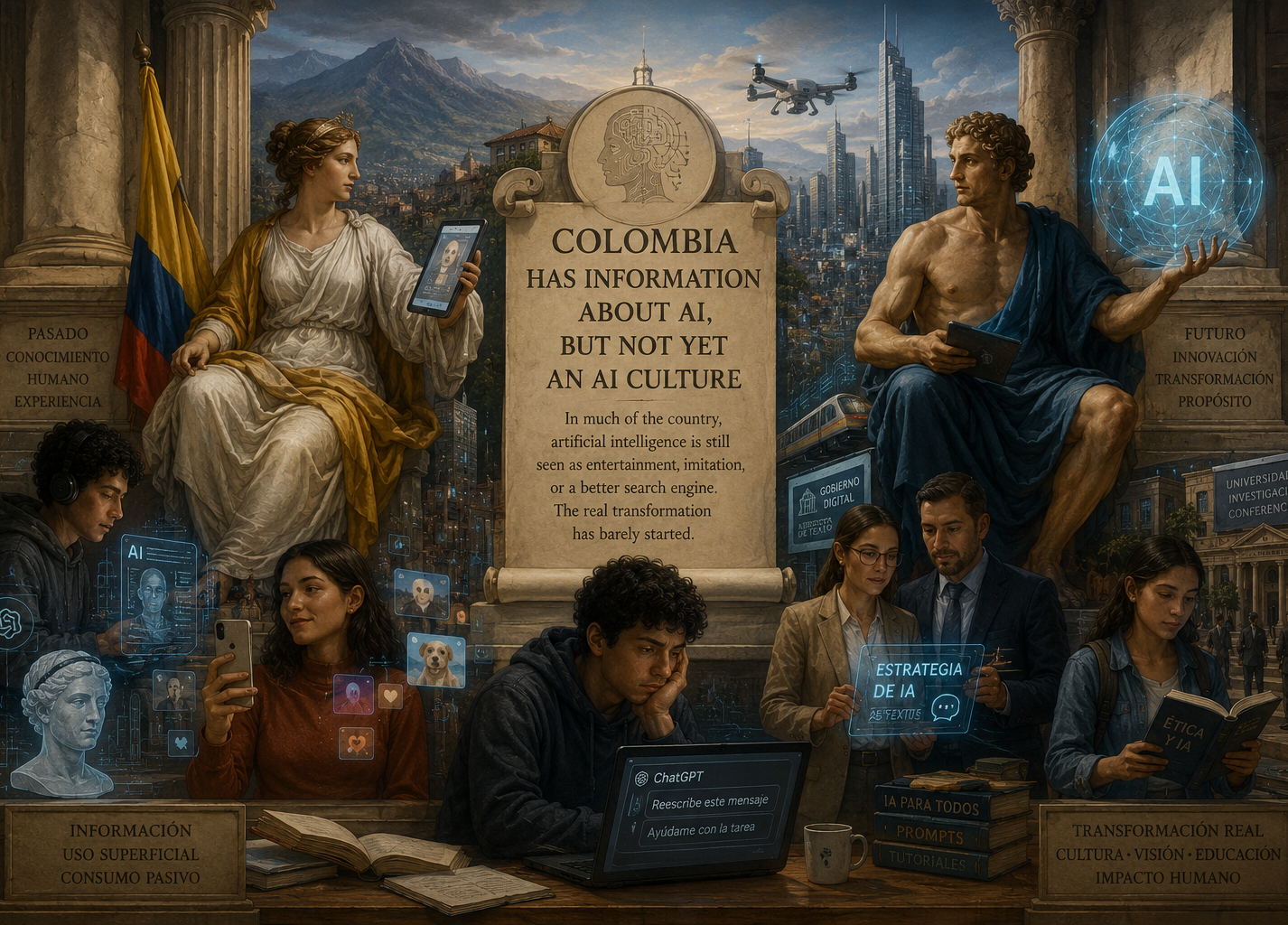
In Colombia, artificial intelligence is already visible everywhere. People generate images, clone voices, make videos, summarize documents, and ask ChatGPT to rewrite messages or help with homework. Government offices experiment with text assistants. Universities organize conferences. Companies publish AI strategies on LinkedIn.
But beneath this growing visibility there is a deeper reality: AI remains profoundly underutilized.
The problem in Colombia is not the absence of information about artificial intelligence. The problem is that AI is still understood in a very narrow way. In many small towns and municipalities, the technology is associated almost exclusively with visual entertainment, social media manipulation, scams, or automated content generation. In the public sector, the most common use cases are still limited to summarizing documents, improving writing, drafting emails, or functioning as a kind of advanced encyclopedia.
The country is consuming AI, but not yet reorganizing itself around AI.
That distinction matters.
Across many Colombian institutions, artificial intelligence is treated as an accessory tool rather than an operational layer capable of redesigning processes, reducing bureaucracy, improving coordination, or expanding state capacity. The technology often enters organizations through isolated experimentation instead of structural transformation.
This is not unique to Colombia. Research on AI adoption in public administration across Latin America shows that many governments still perceive AI mainly as a technical support tool rather than as infrastructure for institutional redesign. Persistent barriers include weak digital infrastructure, fragmented data systems, limited budgets, and lack of specialized talent.
However, Colombia reflects these tensions in a particularly visible way because it combines ambitious digital rhetoric with strong regional inequalities.
In Bogotá, Medellín, and parts of the private technology sector, there is growing awareness that AI can reshape productivity, logistics, finance, education, customer service, and software development. But outside these concentrated urban ecosystems, adoption often becomes superficial. Many people interact with AI daily without understanding how deeply it could alter workflows, institutions, or economic organization.
The result is a strange paradox: AI feels socially present but economically absent.
Part of this comes from how generative AI entered society. For millions of people, the first contact with AI was not through automation or scientific computing, but through memes, synthetic voices, image generators, and viral videos. Deepfakes and entertainment became the public face of artificial intelligence.
This matters because first impressions shape institutional imagination.
If AI is culturally framed as a novelty tool, organizations struggle to see it as infrastructure. Municipal governments continue operating with paper-like workflows even while employees use ChatGPT in browser tabs. Public servants use AI to rewrite reports, but not to redesign citizen services. Small businesses use it for marketing posts but not for inventory forecasting, procurement optimization, or operational planning.
The technology enters through the surface of communication rather than the core of decision-making.
Yet globally, the most important AI deployments in government are increasingly happening far beyond text generation.
Internationally, AI is already being used for traffic optimization, urban planning, fraud detection, resource allocation, predictive maintenance, emergency response coordination, public service triage, and administrative automation. Studies of local governments worldwide show hundreds of operational AI use cases beyond chatbots or document assistance.
In many countries, governments are beginning to understand that AI’s real value is not only producing content faster, but reducing institutional friction.
That means reducing the time citizens wait for approvals. Detecting anomalies in procurement systems. Identifying infrastructure failures before collapse. Coordinating social programs more efficiently. Managing transportation systems dynamically. Automating repetitive bureaucratic tasks that consume thousands of labor hours.
The OECD has argued that AI can free public servants from repetitive administrative work and allow them to focus on tasks requiring judgment and human discretion.
Colombia has only begun to approach this stage.
The public sector still operates under a strong culture of procedural caution. Many agencies lack interoperable databases. Municipal administrations often do not possess clean or digitized data. Procurement systems are fragmented. Technical talent rotates constantly after elections. And there is still significant institutional fear around automation, especially in environments where digital literacy remains uneven.
In practice, many organizations adopt AI without redesigning the processes around it.
This creates what could be called “cosmetic AI adoption.” Employees use generative tools individually, but the institution itself does not fundamentally change.
In much of the country, artificial intelligence is still seen as entertainment, imitation, or a better search engine. The real transformation has barely started.
Scalar Pivot
A government worker may summarize PDFs faster, but citizens still wait weeks for permits because the underlying workflow remains bureaucratic. A municipality may use AI-generated communications while continuing to process records manually across disconnected systems.
The deeper transformation requires something more difficult than buying software: organizational redesign.
And this is where Colombia could eventually surprise observers.
Paradoxically, countries with weaker institutional infrastructure sometimes have opportunities to leapfrog older systems. Because many Colombian municipalities still operate with incomplete digitization, they may eventually adopt AI-native workflows directly instead of transitioning through decades of legacy software.
A small municipality with limited staff could theoretically use AI systems to automate citizen requests, classify documents, monitor infrastructure reports, generate administrative drafts, and coordinate internal workflows with far fewer human bottlenecks than traditional bureaucracies required.
In healthcare, AI could eventually assist overwhelmed regional hospitals with triage systems, medical transcription, scheduling, and diagnostics support. In education, teachers in under-resourced schools may use AI tutoring systems to compensate for gaps in instructional capacity. In agriculture, small producers could use predictive climate and pricing tools previously accessible only to large agribusinesses.
The long-term significance of AI in countries like Colombia may not come from replacing workers, but from amplifying institutional capacity where capacity was historically weak.
This is especially important in Latin America, where many public institutions operate under chronic overload rather than excess labor efficiency.
The future Colombian AI divide may therefore not be between people who use AI and people who do not. It may be between organizations that integrate AI into operational systems and those that use it only cosmetically.
One municipality may continue using AI to draft speeches. Another may redesign how citizens interact with the state.
One company may generate marketing images. Another may rebuild logistics, customer service, and planning around AI-assisted operations.
One school may ban AI entirely. Another may reorganize learning around it.
The countries that benefit most from AI over the next decade may not be those with the loudest public conversations about the technology. They may be the ones capable of quietly embedding it into everyday institutional processes.
Today, Colombia still appears to be in the early cultural phase of AI adoption: fascination without deep integration.
But that phase will not last forever.
As costs fall, models improve, and AI tools become embedded into ordinary software, the conversation will gradually move away from image generators and chatbot novelty. The real question will become whether Colombian institutions can reorganize themselves fast enough to use artificial intelligence not merely as a writing assistant, but as a mechanism for increasing national capacity itself.
That transformation has barely started.
Analysis by

Decision science researcher focusing on second-order effects and the time-based economics of technology. Expert in workflow optimization and cognitive load management.