
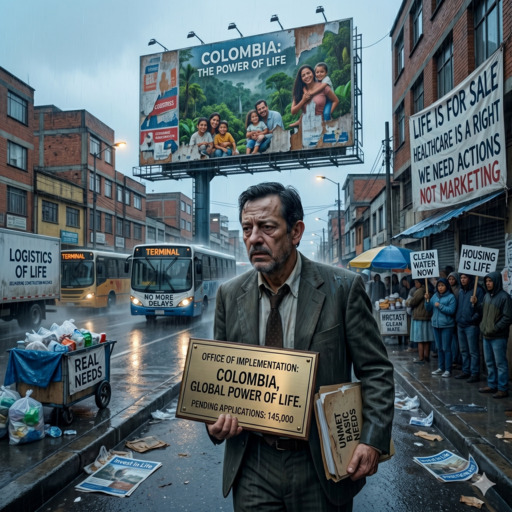
How countries are trying to turn biodiversity, clean energy, and nature into economic, political, and technological influence.
For decades, countries competed globally using relatively clear narratives: cheap manufacturing, financial stability, oil, tourism, technological innovation, or military power.
But in recent years another category of international competition has emerged: green branding.
Today, several governments are trying to position themselves as territories of biodiversity, sustainability, clean energy, and ecological transition. Nature is no longer only environmental heritage. It has also become an economic and geopolitical narrative.
Nature is beginning to acquire direct geopolitical value.
In that context, Colombia is attempting to build a new international identity around concepts such as “world power of life,” biodiversity, energy transition, and environmental protection.
The question is whether this kind of narrative actually works — and how deep the transformation behind the marketing really is.
The Rise of Green Branding
National branding has always existed.
- Singapore sold itself as an efficient financial hub.
- South Korea built an image around technological innovation and pop culture.
- The United Arab Emirates invested heavily in futurism and infrastructure.
But climate change, ESG pressure, the energy transition, and new global investment flows created a new symbolic market: the market for “green” countries.
Governments now want to attract:
- climate investment,
- ecological tourism,
- international financing,
- clean energy companies,
- data centers powered by renewables,
- low-carbon industries,
- diplomatic legitimacy in climate forums.
Sustainability started functioning as a reputational signal.
It is not accidental that many countries are trying to reposition themselves at the same time.
The Global Competition for Ecological Narratives
Costa Rica: The Classic Case
Costa Rica is probably the most successful example of modern green branding.
The country managed to associate its international identity with:
- ecotourism,
- forest protection,
- renewable energy,
- environmental stability.
Importantly, the narrative produced real economic consequences. Ecotourism became a central part of the economy and helped consolidate a very strong international reputation.
Biodiversity can also function as symbolic economic infrastructure.
Norway: Managed Contradiction
Norway represents another, more complex variation.
The country leads global narratives around electric mobility, energy transition, and sustainability. But at the same time it remains a major producer of oil and gas.
This reveals a central characteristic of contemporary green branding: many countries are not necessarily abandoning extractive industries. Instead, they are trying to manage the contradiction while building climate legitimacy.
Sustainability therefore functions both as partial transformation and as diplomatic strategy.
Chile: Lithium and Solar Energy
Chile is trying to position itself as an energy transition power through:
- lithium mining,
- green hydrogen,
- solar energy,
- institutional stability for climate investment.
Here, green branding is less associated with biodiversity and more with future energy infrastructure.
The narrative is not “untouched nature,” but rather “strategic supplier for the decarbonized economy.”
Brazil: The Amazon as a Geopolitical Asset
Brazil has a unique advantage: the Amazon rainforest.
The Amazon is no longer only national territory. It has become a global symbol of climate change and planetary biodiversity.
That gives Brazil enormous international influence, especially when governments prioritize environmental agendas. Forest protection can translate into investment, diplomatic power, and negotiating leverage.
But it also creates permanent tension: when deforestation or environmental conflicts increase, international reputation deteriorates quickly.
Colombia and the “Power of Life”
In the case of Colombia, green branding operates on several simultaneous levels.
The country is trying to move partially away from historical narratives associated with:
- armed conflict,
- drug trafficking,
- violence,
- traditional extractivism.
And replace them with narratives linked to:
- biodiversity,
- water,
- rainforest,
- nature tourism,
- energy transition,
- climate leadership.
The phrase “world power of life” attempts to condense a symbolic transformation.
There are structural reasons for attempting it.
Colombia possesses:
- one of the highest levels of biodiversity on the planet,
- enormous water resources,
- strong renewable energy potential,
- a strategic position between oceans and ecosystems,
- growing attractiveness for nature tourism.
In theory, all of this fits well within the emerging global economy around sustainability and low-carbon development.
The Problem: Branding Without State Capacity
The difficulty appears when the international narrative advances faster than the real infrastructure.
Many countries discover that green branding initially works as reputation, but eventually requires concrete results:
- modern electrical grids,
- effective environmental protection,
- reduced deforestation,
- territorial security,
- energy governance,
- regulatory capacity,
- scientific and technological infrastructure.
That is where many strategies begin to weaken.
Ecological transition does not depend only on environmental discourse. It also requires institutions capable of coordinating investment, energy, territory, and industry.
And that is especially difficult in Latin American economies that still depend heavily on extractive sectors.
Marketing often arrives before real change.
The Risk of the Green “Visual Economy”
Green branding can also become a kind of international visual economy.
Governments produce:
- campaigns,
- slogans,
- climate summits,
- environmental diplomacy,
- biodiversity videos,
- sustainability metrics.
But structural changes move slowly.
In some cases, branding functions more as a reputational mechanism to attract capital and investment before deep material transformation actually exists.
That does not necessarily mean the narrative is false. It means that marketing often arrives before real change.
The important question is how long that gap can be sustained.
Nature as a Strategic Asset
Beyond its contradictions, green branding reveals something deeper about the global economy.
For decades, many Latin American countries were seen mainly as commodity exporters. Now some are trying to redefine their comparative advantages around:
- biodiversity,
- water,
- renewable energy capacity,
- carbon capture,
- relative climate stability.
In a world marked by energy stress, climate change, and environmental pressure, possessing forests, water, and renewable energy potential could become an economic advantage comparable to having oil in the twentieth century.
That helps explain why so many governments are trying to symbolically claim ownership of the green transition before the new global economic map fully consolidates.
The Real Test
The success of green branding will probably not depend on slogans, but on something much more difficult: transforming ecological reputation into real productive capacity.
Countries that manage to do that could attract new industries, climate financing, technological infrastructure, and diplomatic relevance.
Those that fail may end up with nothing more than an aesthetic identity of sustainability.
The competition has already started.
And Latin America, for the first time in a long time, may possess natural advantages that the rest of the world genuinely needs.
Analysis by

Decision science researcher focusing on second-order effects and the time-based economics of technology. Expert in workflow optimization and cognitive load management.