
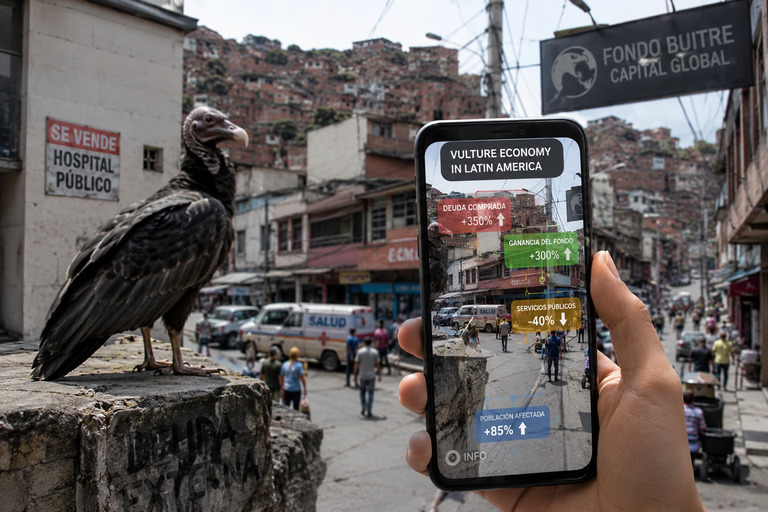
How platforms, debt, insecurity, and digital desperation are reshaping everyday life across the region.
For decades, Latin America struggled with familiar economic problems: inflation, inequality, corruption, weak institutions, informality, and dependence on commodity cycles.
But a quieter transformation is now taking place across the region.
A growing part of the economy no longer depends on building stable industries, improving productivity, or expanding long-term prosperity. Instead, many business models increasingly profit from instability itself.
From app-based labor in Bogotá to online betting in Brazil, from debt apps in Mexico to speculative “AI income” courses in Argentina, a new economic logic is spreading across Latin America:
Human vulnerability has become highly profitable.
Call it the Vulture Economy.
It is an economy that feeds on anxiety, precarious work, emotional exhaustion, and permanent uncertainty. Like a vulture feeding on weakened systems, these business models thrive where institutions are fragile and people are under pressure.
And few regions offer more fertile conditions for this model than Latin America.
The Perfect Environment for Extraction
Latin America entered the digital era with structural vulnerabilities already in place.
- Large informal economies
- Weak labor protections
- Low salaries
- Expensive housing
- Distrust in institutions
- Unequal access to education
- High youth unemployment
Then smartphones arrived.
Suddenly, millions of people gained access not only to information and opportunity, but also to highly optimized systems designed to monetize their attention, aspirations, fears, and economic desperation.
The result is a form of extraction that feels modern, frictionless, and technologically advanced — even when it reproduces very old patterns of inequality.
In the past, extraction often came through raw materials.
Today, it increasingly comes through behavior.
“I Work All Day and Still Feel Broke”
On the streets of Bogotá, São Paulo, Mexico City, Buenos Aires, and Lima, app-based workers have become one of the clearest symbols of this transformation.
Carlos, a 29-year-old delivery rider in Bogotá, says he works nearly 12 hours per day across multiple apps.
“If I stop working for even two days, everything falls apart. Rent, food, my phone bill. The apps give flexibility, but the truth is you are always available. You never disconnect.”
Like millions across the region, Carlos exists inside a permanently unstable economic loop: constant work without long-term security.
The platform economy offers immediate income, but often without healthcare, retirement systems, paid leave, or real bargaining power.
In Latin America, where formal employment is already difficult to obtain, platform labor grows rapidly precisely because insecurity already exists.
Fragility is not a problem to eliminate. It becomes an operational advantage.
Selling Escape During Economic Anxiety
Across YouTube, TikTok, Instagram, and Telegram channels in Spanish and Portuguese, another industry has exploded in recent years: digital aspiration markets.
- “Become financially free.”
- “Earn dollars from home.”
- “Use AI to escape poverty.”
- “Quit your 9-to-5.”
- “Make passive income in 30 days.”
In countries facing inflation, unstable currencies, or declining purchasing power, these messages become extraordinarily powerful.
Luciana, a 24-year-old university graduate in Argentina, says she spent months buying online courses promising remote AI jobs and financial independence.
“Everyone online looked successful. They said the traditional economy was dead and AI was the future. I felt pressure to move fast or be left behind.”
After spending hundreds of dollars on courses and mentorship programs, she says she still struggles to find stable work.
“At some point I realized they were mostly selling motivation to desperate people.”
Not all online education is fraudulent. Many digital learning programs genuinely help people access new opportunities.
But the broader ecosystem increasingly monetizes aspiration itself.
Hope becomes the product.
And in economically anxious societies, hope scales extremely well.
Gambling, Trading, and the Financialization of Desperation
Another rapidly growing sector across Latin America is digital betting and speculative finance.
Online casinos, sports betting apps, crypto speculation, leveraged trading groups, and “financial influencer” culture have expanded aggressively across the region, especially among younger audiences.
In Brazil, online betting platforms have become deeply integrated into football culture and influencer marketing. In Mexico and Colombia, crypto speculation often spreads through social media narratives promising escape from economic stagnation.
For many young people, traditional wealth accumulation feels increasingly inaccessible.
- Owning property appears distant
- Stable careers feel uncertain
- Salaries lose value against inflation
Under those conditions, speculation begins to feel rational.
Diego, a 22-year-old in Medellín, says many of his friends no longer believe conventional work alone can provide upward mobility.
“People feel they need a shortcut. Crypto, betting, trading, whatever. Nobody trusts the system anymore.”
The danger is not only financial loss.
It is the normalization of economic instability as a permanent psychological condition.
The Attention Economy Arrives in Latin America
The region’s digital transformation has also imported one of Silicon Valley’s most powerful business models: attention extraction.
Algorithms reward outrage, emotional conflict, fear, tribal identity, and continuous engagement.
In Latin America — where political polarization, insecurity, and institutional distrust are already high — these systems can become even more destabilizing.
News increasingly competes not on accuracy alone, but on emotional intensity.
Social media rewards reaction over reflection.
Influencers learn quickly that anxiety performs better than nuance.
The result is an information environment where emotional exhaustion becomes economically valuable.
Human attention becomes raw material.
Cities Designed for Investors, Not Residents
The vulture economy is also reshaping urban life across Latin America.
In parts of Mexico City, Medellín, Rio de Janeiro, Buenos Aires, and Bogotá, entire neighborhoods are increasingly redesigned around tourism, short-term rentals, remote workers, and foreign capital.
The transformation often looks modern and cosmopolitan on the surface:
- Specialty coffee shops
- Coworking spaces
- Luxury apartments
- Startup branding
- “Innovation districts”
But underneath, many residents experience rising rents, displacement, wage pressure, and shrinking access to housing.
Camila, a designer living in Mexico City, says several of her friends have already left central neighborhoods because prices became unaffordable.
“The city starts feeling like it belongs more to investors and foreigners than to the people who grew up there.”
The city itself becomes a product.
The resident becomes secondary.
AI and the Next Stage of Extraction
Artificial intelligence may accelerate these dynamics even further.
Not because AI is inherently harmful, but because optimization systems tend to follow existing incentives.
And many current incentives reward behavioral capture rather than human flourishing.
AI systems can already personalize advertising, manipulate engagement, predict emotional reactions, and automate persuasion at massive scale.
In regions with weak regulation and high economic vulnerability, the risks become especially significant.
The danger is not simply smarter technology. The danger is smarter extraction.
Latin America may become one of the world’s largest testing grounds for low-cost digital extraction:
- Cheap labor
- Weak protections
- High connectivity
- Populations eager for economic mobility
The Alternative Future
But this is not the only path available to the region.
Latin America also has enormous potential in renewable energy, scientific talent, software development, public digital infrastructure, creative industries, and AI adoption adapted to local realities.
The central question is whether technology will be used to expand human capability — or simply to optimize instability.
The next decade may define that choice.
One Path
- Productivity
- Resilience
- Knowledge
- Long-term development
The Other
- Dependency
- Exhaustion
- Addiction
- Permanent insecurity
Both systems are already growing simultaneously across Latin America.
And increasingly, the difference between them is not technology itself.
It is the incentives societies choose to reward.
Analysis by

Decision science researcher focusing on second-order effects and the time-based economics of technology. Expert in workflow optimization and cognitive load management.