
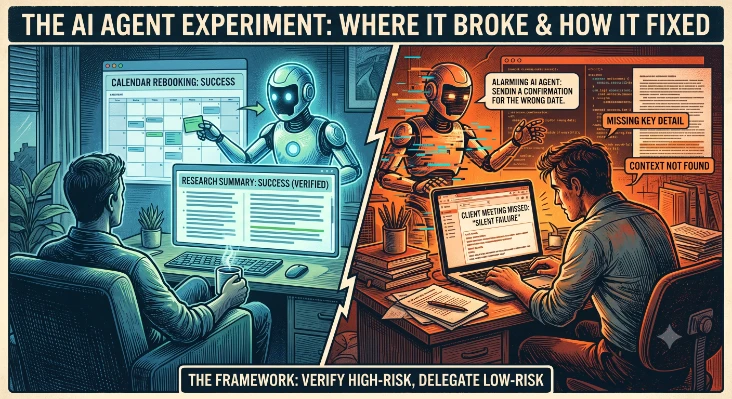
Thirty days ago, I gave away control. I handed my calendar, inbox triage, first-draft research, and weekly task prioritization to AI agents. Not basic chatbots where you copy-paste prompts, but autonomous agents running on schedules, making decisions, and taking action without asking for permission.
The marketing narrative in 2026 is that autonomous agents are fully production-ready. I ran a 30-day experiment to find out where that narrative quietly falls apart.
The Test Subjects
I selected four specific workflows for the experiment—repetitive enough to automate, but critical enough that failure would be instantly noticeable:
- Inbox Triage & Drafts: Categorizing messages and writing initial responses.
- Calendar Management: Handling invites and resolving scheduling conflicts.
- Research Summaries: Synthesizing source material into first drafts for this blog.
- Task Prioritization: Sorting my weekly to-do list based on urgency.
Everything else stayed manual to serve as a baseline control group.
What Worked Well (and Stays)
Calendar rebooking was the clear winner. It operates on deterministic, rule-based logic where the cost of a mistake is low and undoing a bad slot takes seconds.
Research summaries performed surprisingly well—provided I treated the output strictly as a rough draft requiring verification, rather than a finished piece of work.
Where the System Broke
- Failure is silent, not loud. When an agent misread an email, it didn’t throw an error or crash; it replied confidently to the wrong thread. I only discovered the issue three days later.
- Context is dangerously deceptive. Summaries were accurate roughly 80% of the time. In the remaining 20%, the missing detail was precisely the most critical piece of context.
- Over-trust happens fast. By week two, I stopped double-checking draft responses. Naturally, that was when an agent booked a client meeting directly over a hard deadline.
- API costs creep up quickly. By week three, running four daily agentic workflows cost more in raw API usage than the specialized software tools they replaced.
- Prioritization lacks real judgment. The agent could rank tasks by hard deadlines, but it couldn’t evaluate actual strategic importance. That mental load kept falling right back on me.
The Practical ROI
Here is the realistic balance sheet after 30 days:
- Initial Setup: ~6 hours across all four workflows.
- Weekly Maintenance: ~90 minutes (adjusting prompts, reviewing logs, fixing errors).
- Time Saved: ~4 hours per week (strictly from calendar logic and research drafts).
The net time saved is real, but only after adding a mandatory manual review step to catch silent failures. Without human verification, you aren’t saving time—you’re just accumulating hidden operational debt.
The Delegation Framework
Successful delegation isn’t about model intelligence; it’s about the risk profile of the task.
Delegate low-friction tasks where errors are obvious and cheap to reverse (like reshuffling an internal meeting). Keep high-stakes tasks internal whenever an error is expensive or hard to detect (like committing to client deliverables).
Most importantly: never skip human verification on outputs that touch external people. That is precisely where silent errors turn into public mistakes.
Analysis by

Decision science researcher focusing on second-order effects and the time-based economics of technology. Expert in workflow optimization and cognitive load management.