
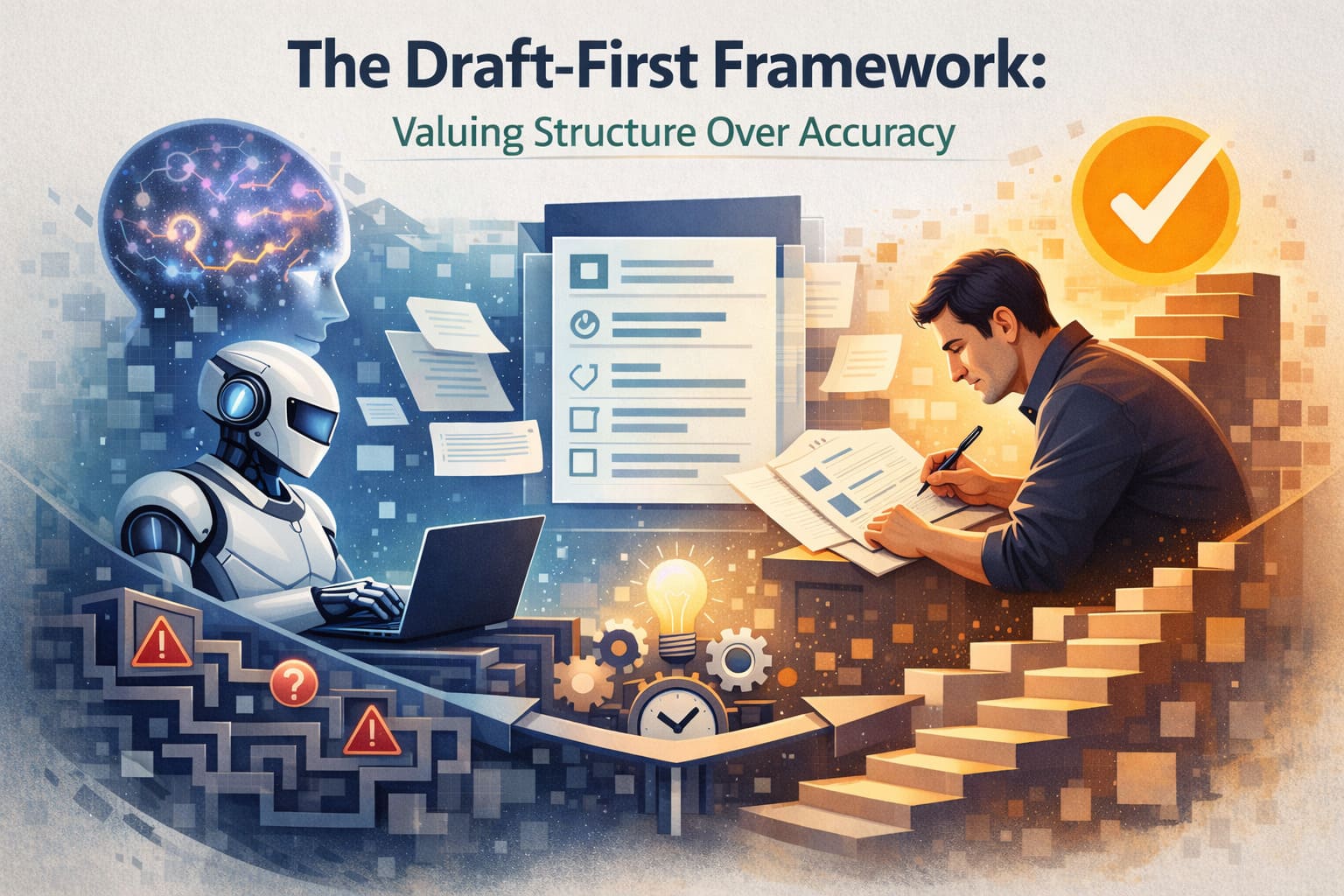
The primary friction in adopting generative AI for professional workflows often stems from a fundamental misunderstanding of the tool’s nature. Users expecting a probabilistic token generator to function as a deterministic knowledge base inevitably encounter “hallucinations”—plausible-sounding but factually incorrect fabrications. This discrepancy leads to a cycle of anxiety, excessive verification, and eventual abandonment of the tool.
The “Draft-First” philosophy reframes the decision to use AI. Instead of evaluating the output as a near-final product demanding accuracy, it evaluates the output as a structural scaffolding that requires human expertise to finalize. By shifting the goalpost from “truth generation” to “friction reduction,” the risk profile of using AI changes significantly. This approach accepts inaccuracy in exchange for cognitive velocity.
Analyzing Utility: Structural vs. Factual Decisions
To mitigate the risk of hallucination without discarding the tool entirely, users must distinguish between structural utility and factual utility. Large Language Models (LLMs) excel at recognizing patterns and organizing information logically (structure) but struggle to retrieve specific, verifiable data points reliably (facts).
The decision to delegate a task depends on which utility is primary. Delegating structure leverages the model’s strength; delegating facts exposes its greatest weakness. The anxiety surrounding AI use often comes from conflating these two distinct utilities.
| Utility Type | Primary Value | Hallucination Risk Impact | Decision Recommendation |
|---|---|---|---|
| Structural Utility | Outlining, reformatting, tonal shifts, brainstorming alternatives, summarizing themes. | Low. A structural error (e.g., a misplaced paragraph) is easily spotted and corrected during the editing phase. | High suitability for delegation. Accept imperfect drafts to gain momentum. |
| Factual Utility | Citing specific data, historical dates, technical specs, attribution of quotes. | High. A factual error is subtle, looks plausible, and requires external verification to detect. | Low suitability for delegation. Retain human control over data injection. |
The Hidden Costs of Manual Initiation
Deciding not to use AI due to fear of errors incurs its own hidden costs. The primary cost is the cognitive load required to overcome inertia—the “blank page syndrome.” Initiating a complex document, organizing thoughts linearly, and establishing a basic structure consume significant mental energy before any substantive work begins.
The “Draft-First” philosophy argues that the cost of correcting a flawed AI-generated structure is frequently lower than the cognitive cost of creating structure from nothing. By utilizing AI as a zero-draft generator, the user conserves energy for high-value tasks: critical analysis, fact-checking, and refining nuance. The trade-off is exchanging high-effort initiation for moderate-effort verification.
Asymmetric Risk in the Drafting Phase
The fear of hallucination is often disproportionate to the actual consequences during the early stages of work. In a drafting context, risk is asymmetric: the downside of a generated error is low (it gets deleted in Draft 2), while the upside of a generated structure is high (it saves hours of outlining).
Conflating the drafting phase with the publishing phase is a critical error in judgment. An AI hallucination is only dangerous if it survives the editing process and reaches a final audience undetected. The “Draft-First” approach contains the risk within the early stages, where errors are cheap and reversible, rather than expecting perfection at the output stage.
Decision Tool: The Delegation Scalability Matrix
Use this assessment to determine if a specific task is suitable for an AI “Draft-First” approach, or if the risk of verification outweighs the benefit of speed. This tool helps structure the decision of what to delegate to minimize fear of critical errors.
How to use:
Evaluate your proposed task against the four variables below. If a task ranks “High” in multiple Risk Factors, the utility of the “Draft-First” approach decreases rapidly.
| Assessment Variable | Low Risk Indicator (Delegate Draft) | High Risk Indicator (Retain Manual Control) |
|---|---|---|
| 1. Structural Complexity Need for organization over content. |
Task requires organizing messy thoughts, reformatting existing text, or generating alternative layouts. | Task structure is already established, and only specific content filling is needed. |
| 2. Fact-Density Requirement Reliance on specific, falsifiable data points. |
Output is conceptual, opinion-based, or creative (e.g., brainstorming metaphors). | Output requires citations, statistics, specific dates, or technical specifications. |
| 3. Error Detection Visibility Ease of spotting a mistake at a glance. |
Errors are obvious structural flaws or tonal misses that stand out immediately. | Errors are plausible-sounding fabrications that require opening a new tab to verify. |
| 4. Downstream Impact Severity Consequence if an error is missed. |
The output is for personal use or internal brainstorming with low stakes. | The output is client-facing or published publicly where retraction is difficult. |
Disclaimer: This tool is for decision-structuring purposes only. It does not provide financial, legal, or medical advice and does not account for individual-specific constraints or future uncertainty.
Analysis by 
Decision science researcher focusing on second-order effects and the time-based economics of technology. Expert in workflow optimization and cognitive load management.