
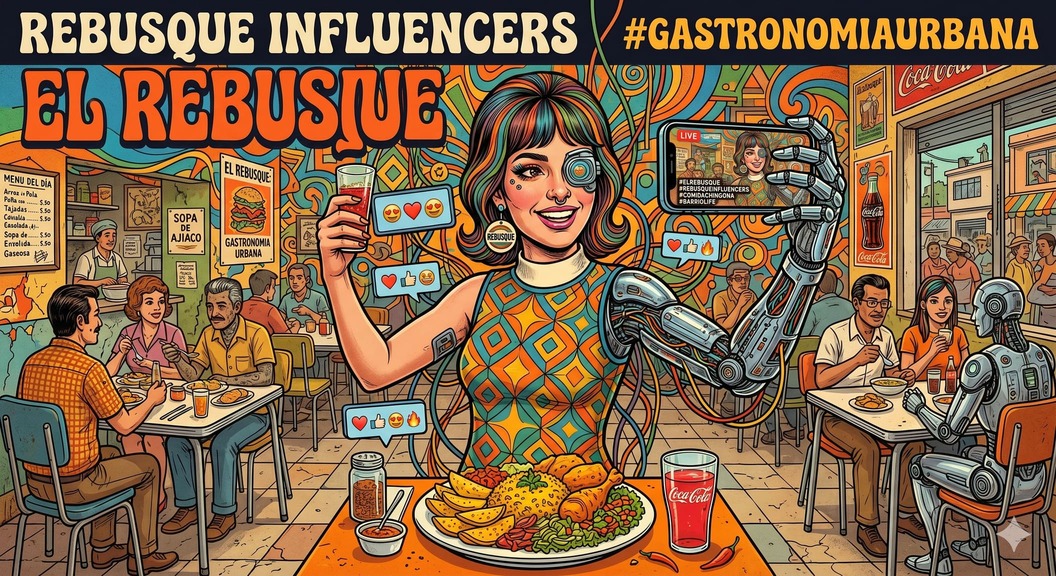
In Bogotá, millions are no longer looking for jobs. They are trying to become platforms.
On the streets of Bogotá, a quiet transformation is taking place. It is not happening inside factories, offices, or universities. It is happening on phones.
The dream is no longer “getting a good job.” The dream is escaping the need for one.
A City Turning Itself Into Content
A young woman records herself tasting a $4 lunch in a working-class neighborhood, exaggerating every facial expression to signal pleasure and surprise. A man sells imported sneakers through Instagram stories. A taxi driver livestreams his day hoping to build an audience.
A student tries to become a fitness influencer. A mother starts reselling beauty products through TikTok Shop. A recently unemployed professional launches a “personal brand” explaining productivity tips to strangers online.
At first glance, this looks like entrepreneurship. A wave of creativity. A digital democratization of opportunity.
But beneath the surface, something darker may be emerging: an economy where millions of people no longer aspire to stable work, but to becoming human advertising infrastructure.
From Career Paths to Visibility Markets
This is no longer limited to aspiring celebrities or tech-savvy university students. In large Latin American cities, especially where labor markets are weak and inequality is chronic, the influencer economy has evolved into a mass survival strategy.
For decades, the traditional path out of poverty was relatively clear:
- Education
- Formal employment
- Professional stability
- Gradual upward mobility
That model was imperfect and inaccessible to many, but it still existed as a cultural horizon.
Now that horizon is collapsing.
Young people see exhausted office workers earning mediocre salaries after years of study. Professionals with degrees drive motorcycles for delivery apps. Public sector jobs increasingly depend on political loyalty.
Meanwhile, companies automate entry-level tasks while demanding impossible levels of experience for junior positions.
Social media constantly broadcasts another possibility: visibility itself as labor.
The platforms offer an intoxicating message:
- You do not need permission.
- You do not need credentials.
- You do not need institutions.
- All you need is attention.
Attention becomes currency. Personality becomes capital. Daily life becomes content.
The Monetization of Identity
The consequences are profound. Entire populations begin reorganizing themselves psychologically around marketability.
- Meals become content opportunities.
- Relationships become collaborations.
- Bodies become branding surfaces.
- Neighborhood stores become stages for algorithmic performance.
The micro-influencer economy is especially revealing because it monetizes aspiration at very small scales. Someone with 8,000 followers may receive free hamburgers, discounted clothing, beauty treatments, or tiny sponsorships.
From the outside, this appears trivial. Socially, however, it signals something much larger: recognition.
In unequal societies, recognition itself becomes economic hope.
This helps explain why so many people continue chasing digital visibility despite extremely low probabilities of success.
The influencer economy functions partly like entertainment, partly like informal labor, and partly like a lottery system. Millions participate because traditional systems already feel closed.
In this environment, becoming a “personal brand” feels more rational than submitting résumés into a labor market that appears indifferent or broken.
Platforms as Parallel Labor Systems
TikTok, Instagram, YouTube, and emerging e-commerce ecosystems are no longer merely entertainment networks. They are becoming parallel labor infrastructures.
These systems absorb economic frustration and transform it into endless streams of:
- Content production
- Emotional labor
- Self-exposure
- Algorithmic dependency
The remarkable part is that much of this labor is unpaid.
Millions spend hours every week filming, editing, posting, optimizing engagement, learning trends, studying algorithms, and performing personalities online without guaranteed income.
In previous economic eras, this might have been called speculation. Today it is described as hustle, branding, or entrepreneurship.
The line between empowerment and desperation is becoming increasingly difficult to identify.
When Visibility Outperforms Competence
The most uncomfortable aspect of this transformation is that society now rewards visibility more consistently than competence.
A teacher, engineer, or researcher may struggle financially while a charismatic content creator reviewing street food accumulates sponsorships and social status.
This does not mean influencers are the problem. Most are simply adapting rationally to the incentives surrounding them.
The real issue is structural: an economy producing fewer stable pathways to dignity while digital platforms manufacture the illusion of infinite opportunity.
Two Forms of Dependency
The result is a strange new labor culture where citizens oscillate between two forms of dependency.
Political Patronage
Selling loyalty to local political machines in exchange for contracts or bureaucratic survival.
Algorithmic Patronage
Selling personality, beauty, intimacy, or attention to platforms and brands in exchange for visibility.
Both systems reward performance.
- Both demand constant self-marketing.
- Both blur the boundary between identity and labor.
- Both leave people deeply vulnerable.
A Society of Storefronts
Where does this lead? It is difficult to know.
Perhaps a small percentage will build genuine businesses and independent media ecosystems. Some already have. Social platforms can absolutely create mobility for talented people who previously lacked access to capital or institutional networks.
But at a societal level, there are reasons for concern when millions begin treating virality as economic policy.
A society cannot function if everyone wants to be a storefront and nobody wants to build the store.
Eventually, countries still need engineers, nurses, electricians, logistics workers, scientists, public administrators, technicians, and teachers.
They need institutions capable of generating stability beyond attention markets.
Yet increasingly, younger generations are growing up inside systems where fame appears more attainable than employment, and where self-exposure seems more profitable than expertise.
The Psychological Cost
The deeper tragedy may not be economic. It may be psychological.
When every moment becomes potentially monetizable, people stop experiencing themselves as citizens or workers.
They begin experiencing themselves as permanent performers inside an invisible marketplace.
Not everyone will become rich. Most will not even become influencers.
But millions may continue transforming themselves into advertisements anyway, because in many parts of the modern world, visibility now feels closer to survival than employment does.
Analysis by

Decision science researcher focusing on second-order effects and the time-based economics of technology. Expert in workflow optimization and cognitive load management.